Commemorated by the Orthodox Church on July 21
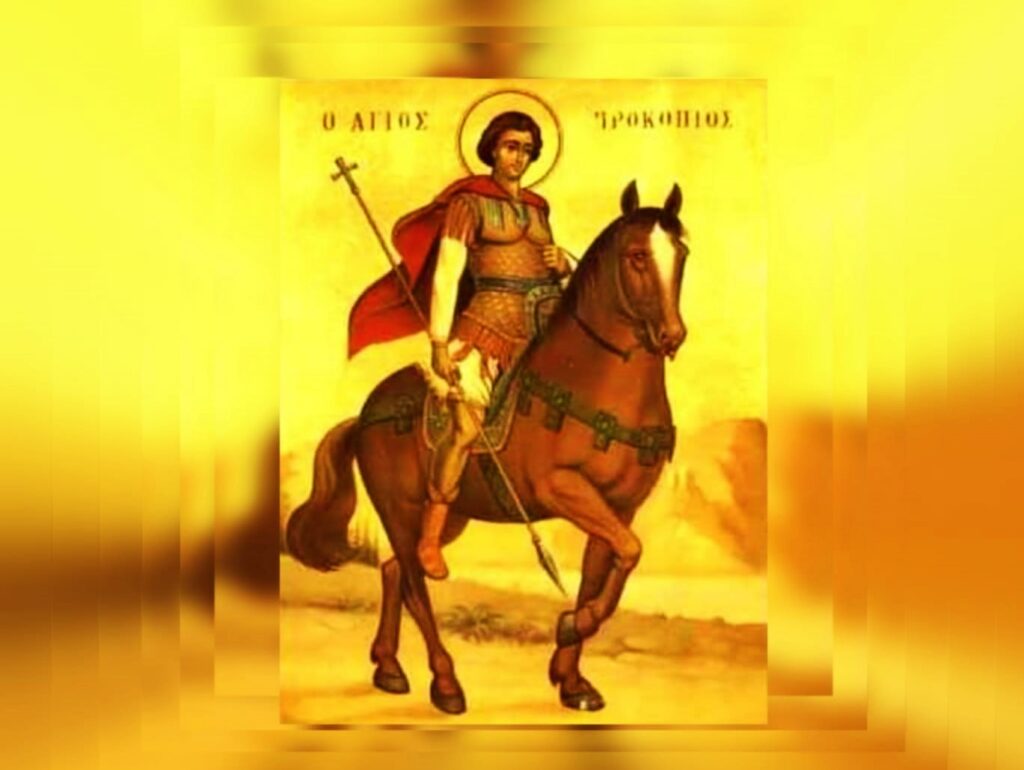
In the heart of Christian history, few stories shine as brilliantly with transformation and triumph as the life of Saint Procopius of Caesarea—once a Roman official named Neanias, later a bold confessor of Christ, and finally a crowned martyr of the Church.
From the Palaces of Rome to the Path of the Cross
Born in the sacred city of Jerusalem, Neanias was the son of a devout Christian father named Christopher and a pagan mother, Theodosia. After losing his father at an early age, Neanias was raised under the spiritual darkness of paganism, molded by Roman culture and customs.
His intellect and ambition caught the eye of Emperor Diocletian, who summoned the young man to his court. There, Neanias rose swiftly through the ranks of Roman government and was eventually appointed as proconsul, entrusted with a deadly task: to persecute Christians in Alexandria during the empire’s brutal crackdown in 303 AD.
But God had other plans.
A Divine Encounter on the Road
While traveling through Syria on his way to fulfill the emperor’s orders, Neanias experienced a vision that would change the course of his life—and history.
Just as Saul of Tarsus once encountered Christ on the road to Damascus, so did Neanias. A blinding light surrounded him, the earth shook, and he heard a divine voice say:
“Neanias, why do you persecute Me?”
He replied, “Who are You, Lord?”
The voice answered, “I am Jesus, the crucified Son of God.”
Then a radiant Cross appeared in the sky, shining brighter than the sun. Overwhelmed by divine grace, Neanias was instantly transformed. No longer a persecutor of the Church, he became its passionate defender.
Warrior of Christ
Neanias ordered a cross to be made in the likeness of the one he saw in his vision. Rather than carrying out his mission to persecute Christians, he led his soldiers into battle to defend Jerusalem from hostile forces, emerging victorious.
Upon returning to Jerusalem, he revealed his conversion to his pagan mother. But his new faith made him an enemy in the eyes of the empire.
Summoned to Caesarea in Palestine and confronted by the imperial governor, Neanias boldly tore up Diocletian’s decree against the Christians. For this “insult to authority,” he was imprisoned and subjected to brutal tortures.
In the darkness of his prison cell, Christ once again appeared to him. The Lord baptized him, giving him a new name—Procopius, meaning “one who progresses.” Thus began his journey from imperial official to holy martyr.
A Martyr’s Courage Ignites the Faith of Many
Despite repeated demands to renounce Christ, Procopius stood firm. His serenity under torment inspired everyone who witnessed it. Even the very soldiers who once guarded him began to believe.
His faith bore fruit quickly:
Twelve women, moved by his courage, openly confessed Christ and were imprisoned with him. Procopius catechized them and prepared them to embrace martyrdom. All twelve received the crown of glory.
His mother Theodosia, watching her son endure torment with unwavering joy, finally abandoned her idols and confessed Christ, joining the company of martyrs.
Several Roman soldiers and commanders, including tribunes Nikostrates and Antiochus, converted and were executed alongside the saint.
The Martyr’s Final Prayer
On the day of his execution, Procopius lifted his hands to the heavens and prayed:
“Lord, remember the poor, the widows, the orphans, and especially Thy Holy Church. Let it flourish and let Thy truth shine until the end of time.”
He then bowed his head and received the martyr’s crown, glorifying Christ with his very last breath.
Saint Procopius was beheaded in Caesarea, Palestine, on July 21, 303. His body, bruised and torn from torture, was buried with honor by fellow believers.
A Defender of Icons and Orthodoxy
Though most known for his martyrdom in the early 4th century, the name Procopius also shines again in Church history during the 8th century through another holy man: Saint Procopius the Decapolite.
Living in the region of Dekapolis, east of the Sea of Galilee, this Procopius was a monastic ascetic and confessor who fearlessly defended the Orthodox faith against the heresy of iconoclasm. Under the wicked Emperor Leo the Isaurian, icons were being destroyed and their veneration condemned.
Saint Procopius stood boldly, teaching the Orthodox understanding:
“We do not worship icons—we venerate them. And that veneration passes to the prototype, Christ Himself.”
For this defense of truth, he suffered imprisonment and torture alongside his fellow ascetic, Saint Basil. Only after the emperor’s death were they released.
Saint Procopius the Decapolite lived the rest of his days in peace, guiding many to Christ until his blessed repose around the year 750.
Why Saint Procopius is Remembered During Orthodox Weddings
Saint Procopius, along with Saints Constantine and Helen, is mentioned during the Orthodox Crowning (wedding) ceremony. His faithful witness, his prayerful intercession, and his heavenly crown serve as a model of self-sacrificing love and union with Christ—the same love to which every Christian marriage is called.
Legacy of Light
On July 21, the Orthodox Church remembers both Saint Procopius the Martyr and Saint Procopius the Confessor—two lights in the history of the faith, one shedding his blood for Christ, the other standing firm against heresy.
From persecutor to preacher, from Roman soldier to heavenly saint, Saint Procopius of Caesarea remains a powerful testament to the transforming power of divine grace and the indestructible courage of faith.