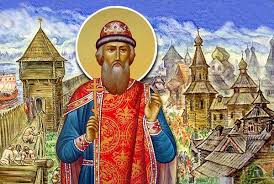
In the vast expanse of Eastern Europe’s Christian history, few figures shine as brightly as Saint Vladimir the Great, Grand Prince of Kiev. His conversion to Orthodox Christianity and subsequent baptism of the Rus’ people in 988 stands as a spiritual milestone, not only for Russia and Ukraine, but for the entire Orthodox Christian world. His life is a powerful testament to the transformative grace of God, who turned a former pagan warlord into a humble servant and builder of the Church.
A Royal Heritage and Tumultuous Rise
Vladimir was born into a complex and powerful dynasty. His father was Prince Sviatoslav, a fierce and ambitious ruler, and his grandmother was none other than Saint Princess Olga, the first Christian ruler of Kievan Rus’. Despite her baptism and pious example, her son Sviatoslav remained a pagan. He divided his realm among his sons before setting off on military campaigns, and it was this decision that led to fraternal conflict.
Vladimir, the youngest, was given Novgorod, while his brothers Yaropolk and Oleg ruled Kiev and the land of the Drevlians, respectively. After Sviatoslav’s death, civil war erupted. Yaropolk killed Oleg and sought to claim Novgorod. Fearing for his life, Vladimir fled across the Baltic Sea to Scandinavia, where he gathered Norse warriors. He returned with force, conquered Kiev, and emerged as the sole ruler of Rus’.
But Vladimir was still a pagan—and an ardent one.
Vladimir, the youngest, was given Novgorod, while his brothers Yaropolk and Oleg ruled Kiev and the land of the Drevlians, respectively. After Sviatoslav’s death, civil war erupted. Yaropolk killed Oleg and sought to claim Novgorod. Fearing for his life, Vladimir fled across the Baltic Sea to Scandinavia, where he gathered Norse warriors. He returned with force, conquered Kiev, and emerged as the sole ruler of Rus’.
But Vladimir was still a pagan—and an ardent one.
Pagan Zeal and Idolatry
Once he secured his power, Vladimir undertook a massive campaign to consolidate pagan worship across his domains. He erected idols of the Slavic gods in prominent places, most notably an imposing statue of Perun, the thunder god, on a hill in Kiev. Human sacrifice was revived in honor of these deities, and persecution of Christians intensified.
A particularly gruesome event from this period was the martyrdom of Theodore and his son John, Christians who refused to bow before the idols. Vladimir ordered the boy to be sacrificed before the idol of Perun. When he refused, both were killed and thrown into the river—echoing early Christian martyrdoms under Roman emperors.
Despite his grandmother Olga’s Christian influence, Vladimir not only remained indifferent to Christ, he actively waged war against Him. Churches were destroyed, clergy fled or were killed, and idol worship dominated Rus’.
A Mysterious Change of Heart
Yet, in this spiritual darkness, the light of Christ was about to shine.
Vladimir’s heart began to change. Perhaps it was the memory of his grandmother. Perhaps it was the martyrdom of the Christians. Or perhaps it was simply God’s grace quietly working in him. He became interested in religion—not just as a matter of curiosity, but as a way of life.
According to the Primary Chronicle, he sent emissaries to study the religions of neighboring lands. They visited the Muslims in Volga Bulgaria, the Jews, the Latin Christians in Germany and Rome, and finally the Orthodox Christians in Constantinople.
The reports from Constantinople were extraordinary. The envoys had attended the Divine Liturgy in the grand Church of Hagia Sophia and were left speechless:
“We knew not whether we were in heaven or on earth… For on earth there is no such vision nor such beauty, and we are at a loss how to describe it.”
The report deeply moved Vladimir. He began to incline toward Orthodoxy, yet he still sought a definitive sign from heaven.
Conquest, Illness, and Baptism
In 988, Vladimir waged war against the Byzantines and laid siege to Chersonesos (present-day Sevastopol). He demanded marriage to Princess Anna, the sister of Emperor Basil II and Emperor Constantine. The condition was non-negotiable: he must be baptized first.
Providentially, Vladimir fell gravely ill—blind and desperate. Princess Anna urged him to receive holy baptism, promising that he would not only be healed physically, but also spiritually. He agreed.
As soon as he was baptized in the Church of Saint Sophia in Cherson, he miraculously regained his sight. The once-hardened pagan warrior now radiated humility and joy. He took the Christian name Basil, in honor of Saint Basil the Great, and married Princess Anna.
The Baptism of a Nation
Upon his return to Kiev, Vladimir began a sweeping transformation of his kingdom. He destroyed pagan idols, including Perun, whose statue he ordered thrown into the Dnieper River. Vladimir then issued a decree:
“If anyone, rich or poor, refuses to be baptized, he is my enemy.”
It was not merely political strategy. Vladimir believed he was acting as a shepherd called to lead his people to salvation.
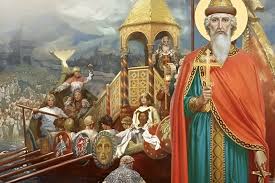
Thousands gathered on the banks of the Dnieper in Kiev, and priests began baptizing the people in great numbers. The chroniclers describe a sacred moment when the whole nation entered the water together, receiving new life in Christ. Vladimir stood nearby, praying fervently:
“O God who created the heavens and the earth, look upon this new people and grant that they may know You as the true God, as the nations of other Christian lands have come to know You.”
It was the Baptism of Rus’, one of the most important moments in the history of Eastern Christianity.
From Prince to Apostle
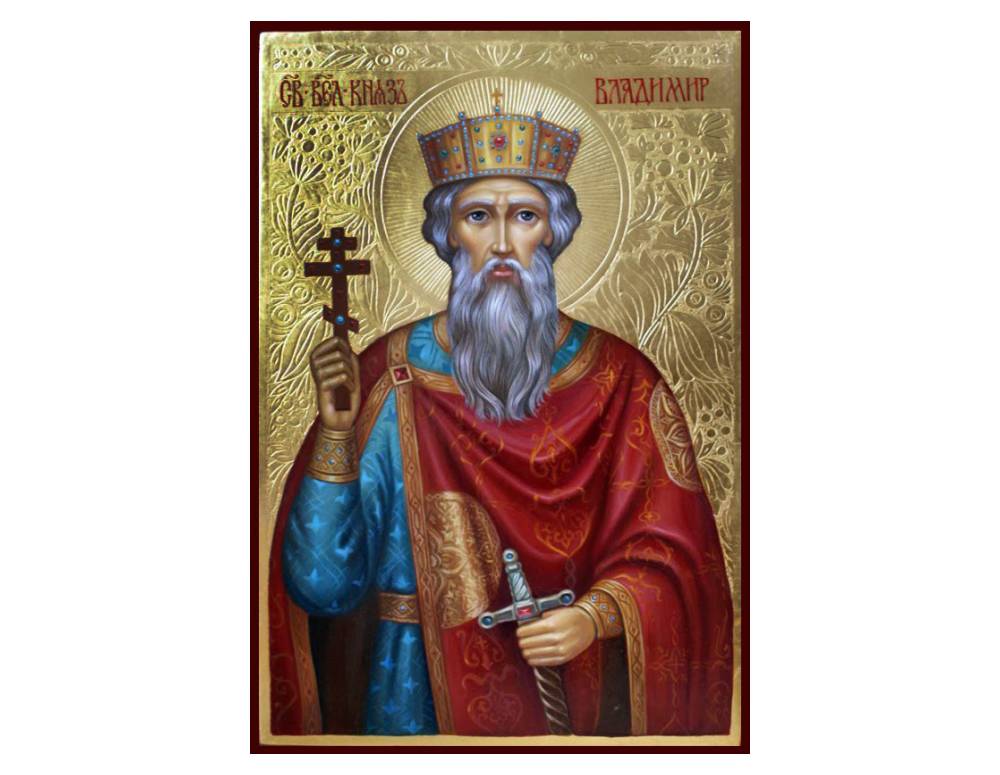
The transformation in Vladimir was complete. He became a true Christian prince—humble, generous, and just. He replaced pagan shrines with churches, supported the construction of schools and monasteries, and brought clergy from Byzantium and Bulgaria to teach the faith.
He enacted laws based on Christian ethics, abolished the death penalty, helped the poor, and lived a chaste life, renouncing his previous lustful ways. His rule marked the beginning of Christian statehood in the Slavic lands.
Though he ruled with authority, he was now guided by Christ-like compassion. His Christian rule became a model for later Orthodox monarchs, from Saint Alexander Nevsky to Tsar Nicholas II.
Falling Asleep in the Lord
Saint Vladimir reposed in peace in the year 1015. His holy relics are enshrined in the Church of the Tithes in Kiev, and his memory is kept on July 15 (New Calendar) or July 28 (Old Calendar). The Church glorifies him as Equal-to-the-Apostles—a title given to those whose missionary work resembles that of the apostles themselves.
He left behind a baptized nation, a foundation of Orthodox civilization, and a legacy of spiritual heroism.
Conclusion: A Legacy That Lives On
Saint Vladimir’s life is a powerful witness to the grace of God, capable of converting even the hardest of hearts. He was once a cruel, lustful idolater—yet he became a radiant beacon of faith and love.
Through him, the Orthodox faith took root in the hearts of the Slavic people, blossoming into a Christian culture that has endured invasions, persecution, and exile.
To this day, Orthodox Christians remember him not just as a king, but as a father in the faith—a saint who, like Saint Paul, was “a vessel chosen” to carry Christ to a nation.