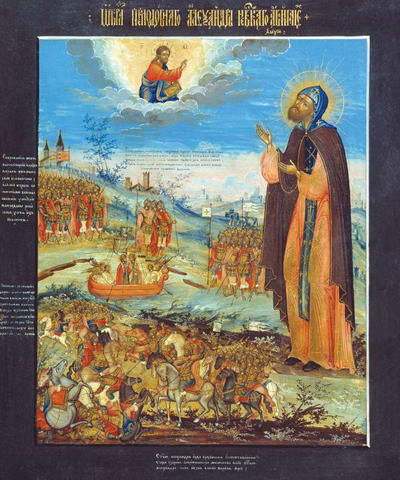
Saint Alexander Nevsky (1221–1263) stands among the most beloved and celebrated Orthodox saints, remembered as a fearless warrior, wise ruler, and faithful defender of the Orthodox Christian faith. His life, filled with both heroic battles and deep spiritual devotion, continues to inspire Orthodox Christians across the world.
A Childhood Turned Toward God
Born on May 30, 1221, in Pereslavl-Zalessky, Alexander was the son of Grand Prince Yaroslav Vsevolodovich. From a young age, his heart was turned toward God. He loved prayer, vigils, and the writings of the Holy Fathers, shunning the vanity of the world. Even in youth, Alexander sought Christ above all else.
Prince of Novgorod and Defender of the Faith
In 1236, Alexander became Prince of Novgorod. Only four years later, on July 15, 1240, he achieved a decisive victory over the Swedish crusaders at the mouth of the Neva River. From that day forward, he was known as Alexander Nevsky.
Before every battle, he inspired his soldiers not with promises of earthly strength, but with eternal truth, declaring:
“God is not in might, but in truth!”
This unshakable faith guided him throughout his life.
Victories Over the Crusaders
After defeating the Swedes, Alexander faced a new threat: the German Teutonic Knights, who had already seized Pskov and advanced into Novgorod lands. On April 5, 1242, Alexander led his forces onto the frozen Lake Peipus and won the legendary Battle on the Ice, routing the heavily armed German crusaders.
These two victories — against Sweden on the Neva and against the Teutonic Knights on Lake Peipus — secured Alexander’s place among the greatest military leaders in history. Even today, his strategies are studied at prestigious military academies worldwide.
Between East and West: A Difficult Choice
Alexander’s time was marked by terrible trials. From the East came the Mongol-Tatar invasion, and from the West, the papal crusaders pressing Russia to abandon Orthodoxy for Roman Catholicism.
Faced with this double threat, Alexander made a difficult decision: he submitted politically to the Mongol Golden Horde, knowing that while their rule oppressed the body, Rome’s influence threatened to corrupt the soul. For him, the preservation of the Orthodox faith was more important than earthly freedom.
Fearless Confessor of Orthodoxy
When summoned before Khan Batu of the Golden Horde, Alexander showed both humility and courage. Refusing to bow before idols, he confessed boldly:
“To you, O Khan, I bow, for God has honored you with a kingdom. But to creatures and idols I will not bow. I am a Christian, I worship the one God, glorified in the Trinity, who created heaven and earth.”
Even the Khan respected him for his wisdom, strength, and dignity.
Later, when papal envoys came urging him to accept Catholicism, Alexander firmly rejected them, declaring:
“We know the true history of the Faith and the Church from Adam to Christ, and from Christ to the Seventh Ecumenical Council. We keep the teachings of the Apostles and the Fathers; your teaching we will not accept.”
With this, he preserved Russia’s Orthodox identity for generations to come.
A Righteous Ruler and Builder
As Grand Prince of Vladimir (from 1252), Alexander devoted himself to strengthening and rebuilding the Russian land devastated by war. He built churches, gave generously to the poor, and governed with wisdom.
He was not only a warrior but also a statesman and diplomat, a man whose decisions were guided by faith rather than ambition.
A Holy End
After twenty-seven years of ruling, sensing his earthly end, Alexander accepted monastic tonsure with the name Alexis. He received Holy Communion and peacefully reposed on November 14, 1263, at the age of 43.
During his funeral in Vladimir, a miracle occurred: when the metropolitan tried to place a prayer of absolution in his hand, Alexander — as if alive — opened his hand and took it himself.
Glorification and Veneration
Alexander was canonized by the Russian Orthodox Church in 1547, and his feast is celebrated on November 23 (the day of his burial) and August 30 (the translation of his relics).
His holy relics, discovered incorrupt in 1380, were later transferred by order of Peter the Great to Saint Petersburg in 1724, where they remain in the Alexander Nevsky Lavra.
For centuries, Alexander Nevsky has been revered not only in Russia but throughout the Orthodox world. Churches, monasteries, hymns, icons, and monuments honor his memory. In Serbia, during the 19th century, Russian volunteers even dedicated a church in Belgrade to him, linking his legacy to the struggles and victories of the Serbian people.
Legacy of a Saintly Warrior
Saint Alexander Nevsky is remembered as:
A fearless defender of Orthodoxy against Western crusaders.
A wise ruler who placed faith above politics.
A self-sacrificing shepherd who endured hardship for his people.
A saint whose intercessions continue to inspire and protect the faithful.
His words — “God is not in might, but in truth!” — remain timeless, reminding us that true victory comes not from power or weapons, but from faith, righteousness, and trust in Christ.
Saint Alexander Nevsky stands as a symbol of Orthodox courage, a protector of truth, and a guiding light for all who struggle to keep faith amidst trials.