Each year, as much of the world puts away its Christmas decorations by the end of December, a sacred stillness begins to descend upon millions of Orthodox Christian homes. Candles are prepared, prayers grow deeper, fasting intensifies, and hearts turn inward. On January 7, according to the ancient Julian calendar, Orthodox Christians celebrate the Nativity of our Lord and Savior Jesus Christ—a feast not merely remembered, but mystically entered.
For nearly 250 million Orthodox and Eastern Christians, Christmas is not a single day of celebration, but a holy season, steeped in prayer, ancient symbolism, and profound spiritual meaning.
Why Do Orthodox Christians Celebrate Christmas on January 7?
The difference in Christmas dates has nothing to do with disagreement over Christ’s birth. Rather, it stems from the calendar used for liturgical life. Several Orthodox Churches continue to follow the Julian calendar, which currently falls 13 days behind the Gregorian calendar used in the West.
Thus:
December 25 (Julian) = January 7 (Gregorian)
This date is observed by:
The Russian Orthodox Church
The Serbian Orthodox Church
The Georgian Orthodox Church
The Coptic Orthodox Church
The Ethiopian and Eritrean Orthodox Tewahedo Churches
For Orthodox Christians, the Nativity is not adjusted to modern timekeeping—it remains anchored in sacred tradition.
The Orthodox Meaning of Christmas: God Becomes Man
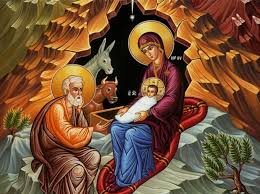
In the Orthodox Church, Christmas is one of the Twelve Great Feasts, celebrating the incomprehensible mystery of the Incarnation:
God Himself takes flesh and is born of the Virgin Mary.
Orthodox theology emphasizes not sentimentality, but salvation. Christ is born so that humanity may be restored, healed, and united to God. This is why Christmas is preceded by the 40-day Nativity Fast, a spiritual journey of repentance, prayer, and preparation.
The Church sings on Christmas Eve:
“Your birth, O Christ our God,
has shone upon the world the Light of knowledge.”
Christmas is light entering darkness—not symbolically, but truly.
Christmas Eve: A Sacred Threshold
The Badnyak – The Oak of Life
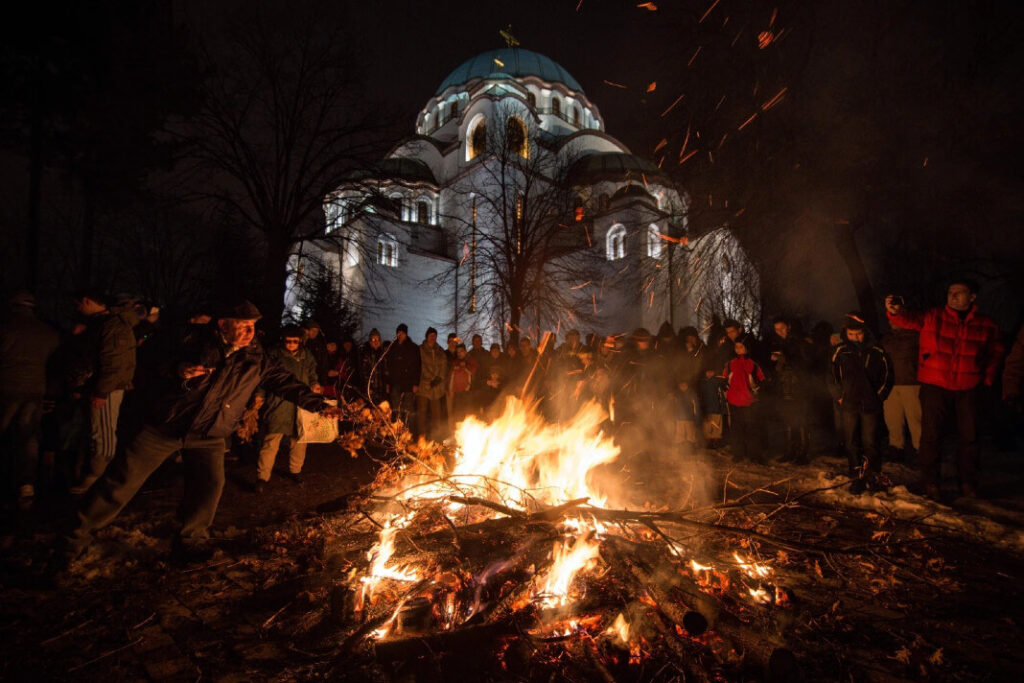
On January 6, known as Chrismas Eve in Serbian Badnyi Dan, the faithful prepare their homes and hearts. The central symbol is the Badnyak, an oak log or bundle of oak branches.
The oak represents:
Strength and endurance
The Tree of Life
Christ Himself, who will be sacrificed for the world
Traditionally, the head of the household cuts the oak in the early morning, facing east, offering prayer and grain before felling it. In the evening, the Badnyak is brought into the home with blessings, wine, and prayers for health, peace, children, livestock, and spiritual joy.
In cities today, small Badnyak bundles—often blessed at church—continue this ancient tradition.
Straw on the Floor: Bethlehem Enters the Home
Straw is spread throughout the house, recalling the cave and manger of Bethlehem. Children imitate chicks while elders scatter walnuts and grain, invoking fertility, abundance, and divine protection.
This moment transforms the home into a living icon of the Nativity—humble, joyful, and filled with expectancy.
The Holy Supper: Fasting with Hope
Christmas Eve remains a strict fast day, yet the supper is rich in meaning. The table is covered with straw and a white cloth, and before eating, prayers are offered or the Troparion of the Nativity is sung.
Traditional foods include:
Bread and salt
Fish
Beans
Sauerkraut
Honey and walnuts
Wine
This meal teaches restraint, gratitude, and spiritual readiness—because Christ is about to enter the world.
The Midnight Mystery: Christ Is Born
In both Serbian and Russian Orthodox tradition, many faithful return to church late at night for All-Night Vigil and Midnight Divine Liturgy. Candles glow in the darkness as the Church proclaims the Nativity—not as history, but as present reality.
In Russia, these services are often led by the Patriarch of Moscow, broadcast nationwide from the Cathedral of Christ the Savior, uniting the faithful in prayer.
The Orthodox Meaning of Christmas: God Becomes Man
In the Orthodox Church, Christmas is one of the Twelve Great Feasts, celebrating the incomprehensible mystery of the Incarnation—that God Himself takes flesh and is born of the Virgin Mary. Christ enters history not as a powerful ruler, but as a helpless Child, born in humility so that fallen humanity might be raised up and restored to communion with God.
This is why Christmas is preceded by the 40-day Nativity Fast, a spiritual journey of repentance, restraint, prayer, and mercy. The Church prepares the faithful not only to commemorate Christ’s birth, but to receive Him inwardly.
On Christmas Eve, the Church sings:
“Your birth, O Christ our God,
has shone upon the world the Light of knowledge.”
Christmas is the moment when divine Light enters the darkness of the world—and the darkness cannot overcome it.
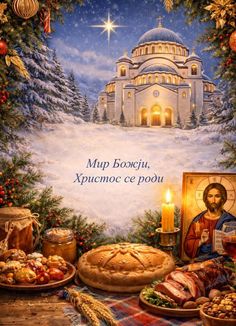
Serbian Orthodox Christmas: Faith Lived in the Home
In Serbian tradition, Christmas is called Božić, derived from the word Bog (“God”), often poetically understood as “the Young God.” It is celebrated not for one day, but over three sacred days, beginning on January 7, and extending the joy of the Nativity into daily life.
From the moment Christmas Day begins, believers greet one another with words that are themselves a confession of faith and a prayer:
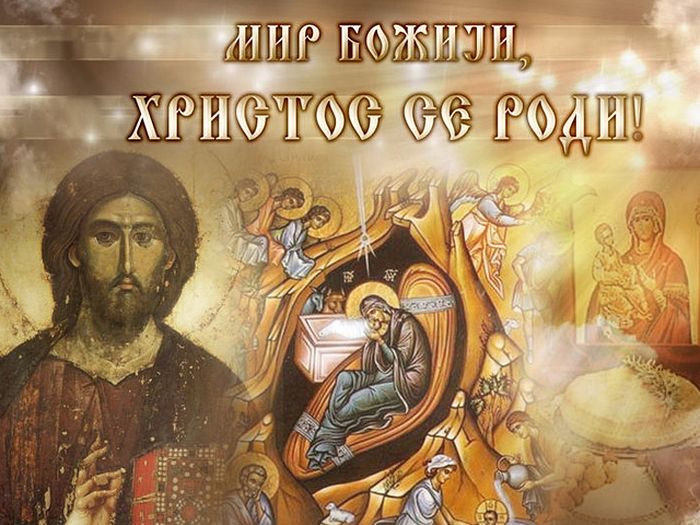
“Mir Božiji – Hristos se rodi!”
(Peace of God – Christ is Born!)
“Vaistinu se rodi!”
(Indeed He is Born!)
This traditional greeting, known as mirboženye, expresses the very heart of the feast. By offering “Peace of God,” one is not merely saying hello, but invoking the divine peace brought into the world through the birth of Jesus Christ, the peace proclaimed by the angels over Bethlehem: “Glory to God in the highest, and on earth peace, goodwill among men.”
The response, “Indeed He is Born,” affirms shared Orthodox faith and joy in the Incarnation. As part of this sacred custom, those who exchange this greeting also kiss one another three times on the cheek, symbolizing love, reconciliation, and unity in the Holy Trinity. This act is deeply spiritual, reminding everyone that no resentment, division, or bitterness should remain in a home where Christ is joyfully received. Mirboženye is not a formality—it is a gesture of forgiveness, renewed harmony, and living peace.
The Midnight Mystery: Christ Is Born
In both Serbian and Russian Orthodox tradition, many faithful return to church late at night for All-Night Vigil and Midnight Divine Liturgy. Candles glow in the darkness as the Church proclaims the Nativity—not as history, but as present reality.
In Russia, these services are often led by the Patriarch of Moscow, broadcast nationwide from the Cathedral of Christ the Savior, uniting the faithful in prayer.
Christmas Morning: Joy Proclaimed
At dawn on January 7, church bells ring, announcing joy to the world. No one eats before receiving the blessed bread (prosphora) brought home from church.
The Polažaynik: The First Blessing
A beloved Serbian custom is the polažaynik, the first person to enter the home on Christmas Day. He stirs the fire, calling forth sparks while praying aloud:
“As many sparks, so much joy,
so much health,
so much blessing in this home.”
This act is both prayer and prophecy—a hopeful offering of the year to come.
The Christmas Feast: Česnitsa and Thanksgiving
The centerpiece of the Christmas table is the česnitsa, a round bread baked with a coin hidden inside. The bread is broken together, never cut, symbolizing unity and divine providence.
Whoever finds the coin is believed to receive special blessing—but all share in the joy.
The table overflows with thanksgiving, often featuring pečenitsa (roasted pork or lamb), wine, and repeated toasts to God’s mercy and peace.
Russian Orthodox Christmas: Faith That Endured Silence
In Russia, Christmas survived decades of persecution under Soviet atheism. Though officially abolished, faith lived quietly in homes, prayers, and memory.
Many traditions—trees, gift-giving, Ded Moroz—were absorbed into New Year’s celebrations. Yet after 1991, Christmas returned openly as a national holiday, restoring its spiritual heart.
Today, Russian Orthodox Christmas is marked by:
Long fasting
Twelve-dish Holy Supper
Deep liturgical worship
Quiet joy rather than excess
It stands as a testimony that faith cannot be erased.
The Twelve Days of Christmas: Living the Nativity
From January 7 to January 18, Orthodox Christians greet one another with:
“Christ is Born!”
“Truly He is Born!”
This sacred period ends with Theophany, the Baptism of Christ, when the Light revealed in the cave of Bethlehem shines forth at the Jordan River.
A Timeless Light for a Restless World
Orthodox Christmas is not rushed. It does not end in one day. It teaches patience, reverence, humility, and hope.
In a noisy world, it offers silence.
In darkness, it offers Light.
In brokenness, it offers Christ.
Christ is Born!
Truly He is Born! ✨