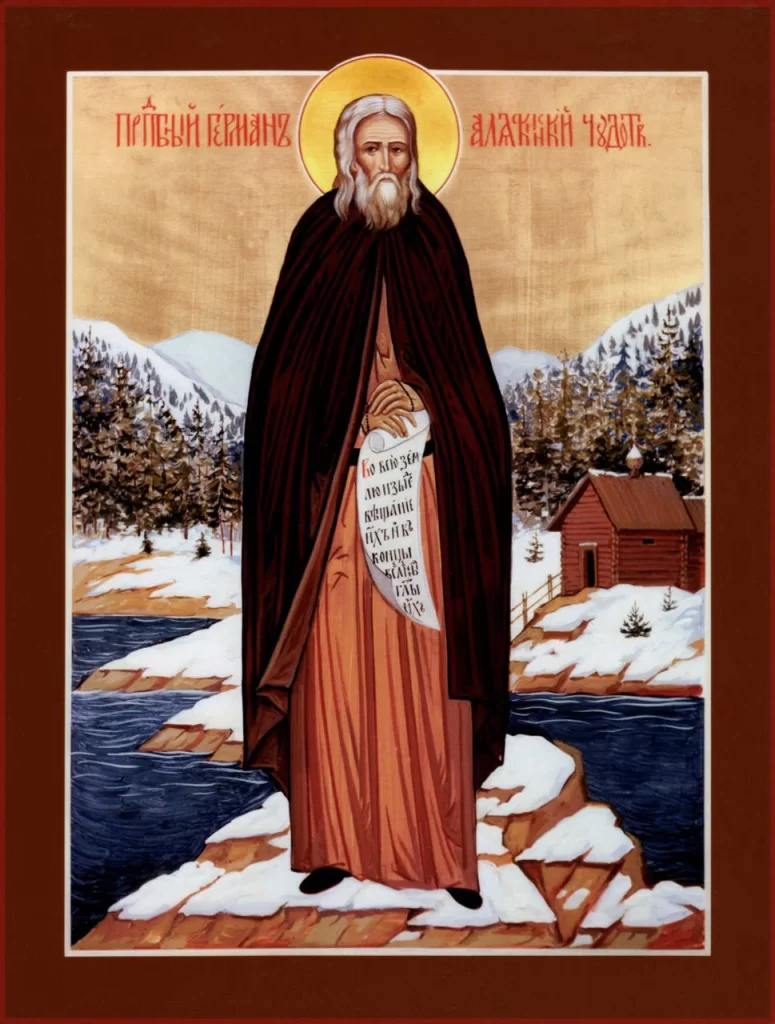
Saint Herman of Alaska stands as a radiant witness that holiness knows no boundaries of geography, culture, or era. A humble monk from Russia, he became the first canonized Orthodox saint of North America, a gentle defender of the oppressed, and a living example of Christ-like love in one of the harshest mission fields in Christian history. His life reveals how deep prayer, humility, repentance, and sacrificial love can transform not only individuals, but entire nations.
Often called the Apostle of Alaska, Saint Herman did not evangelize through force or eloquence, but through compassion, holiness, and unwavering faithfulness to Christ. He preached the Gospel most powerfully through his life—by defending the voiceless, comforting the suffering, and remaining rooted in the ancient Orthodox spiritual tradition.
From Voronezh to the Wilderness: A Soul Formed by Prayer
Saint Herman was born in 1751 in the Voronezh region of Russia as Yegor Ivanovich Popov. From his earliest years, his heart was drawn not to worldly ambition, but to God. As a young boy, he sought the company of holy men and spent time with Father Varlaam, a revered elder and ascetic connected to Sarov Monastery.
By the age of twelve, Yegor had already begun withdrawing into the wilderness—sometimes with his spiritual elder, sometimes alone—learning silence, prayer, and absolute trust in God. These early encounters with solitude shaped his lifelong love for stillness, interior prayer, and continual remembrance of God.
At the age of seventeen, Yegor was conscripted into military service. Though he served primarily in clerical duties, this period became one of intense suffering and spiritual testing. During his service, he developed a severe cancerous growth on his neck, which spread until it disfigured his entire face. When all human help failed, he turned completely to God.
Falling before an icon of the Most Holy Theotokos, he prayed unceasingly through the night with tears. When exhaustion overcame him, he wiped the icon with a towel, wrapped the towel around his face, and fell asleep. In a dream, he saw himself healed—and upon waking, he discovered that the disease had completely vanished. This miraculous healing marked a decisive turning point in his life, sealing his commitment to serve Christ alone.

The Path of Obedience: Sarov and Valaam Monasteries
In 1777, Yegor was released from the army and entered Sarov Monastery as a novice, embracing a life of obedience, fasting, and prayer. Sarov was renowned for its strict asceticism and deep spiritual life, and it profoundly shaped his discipline and humility.
In 1782, he traveled to the famous Valaam Monastery on Lake Ladoga, where he was tonsured a monk and received the name Herman. Valaam was a spiritual lighthouse of Orthodoxy, combining communal worship with the ancient practice of hesychasm—the path of inner stillness and unceasing prayer.
Although admired by the brethren and considered worthy of ordination, Saint Herman consistently refused advancement, considering himself unworthy. Instead, he chose the hidden life, often withdrawing into the wilderness for days at a time to pray, chant the Psalms, and contemplate Holy Scripture.
Mission to Alaska: Orthodoxy in the New World
In 1794, Saint Herman was among a group of monks sent by Metropolitan Gabriel of St. Petersburg to Russian America (Alaska). Their mission was to bring the Gospel to the indigenous Aleut people, who were suffering under the brutal exploitation of the Russian-American Company.
Saint Herman quickly distinguished himself not only as a missionary, but as a fearless defender of the native peoples. He openly confronted colonial authorities for their cruelty, protected families from abuse, and demanded humane treatment—often at personal risk. Though unordained, he taught the faith patiently, catechized converts, baptized believers, and cared for souls with genuine pastoral love.
To the Aleut people, he was not merely a preacher, but a true spiritual father—one who lived among them, shared their hardships, and treated them with dignity and compassion.
Spruce Island: A Desert in the Far North
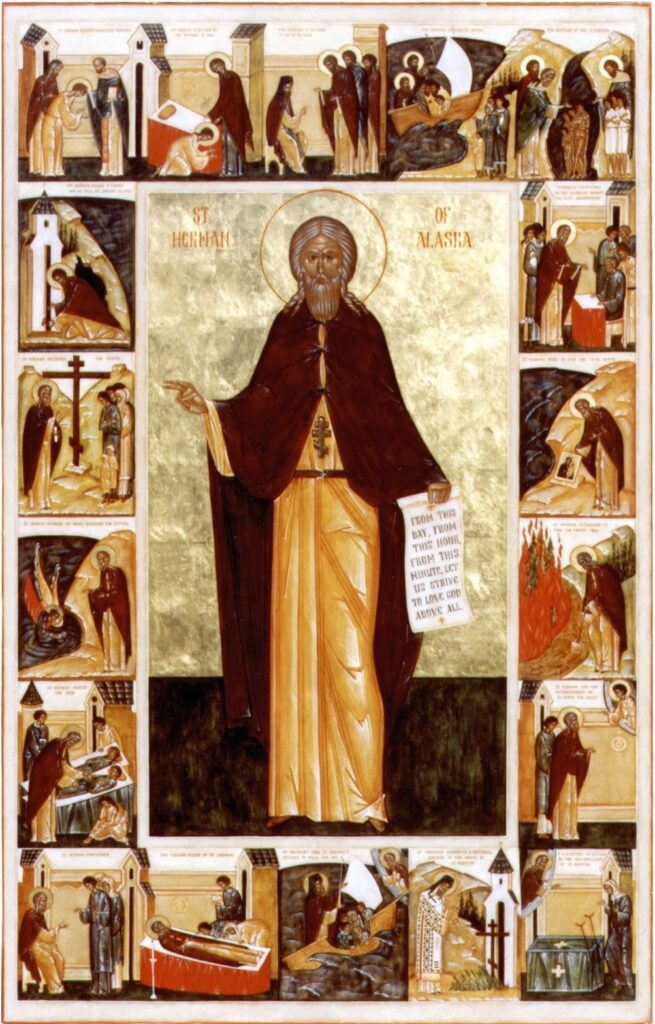
After years of missionary labor, Saint Herman withdrew to Spruce Island, a small forested island near Kodiak, which he lovingly called “New Valaam.” There, he lived a semi-eremitic life while remaining fully accessible to those in need.
His life was one of extreme simplicity. He slept on a wooden bench, wore the same worn clothing for years, and lived on minimal food. Yet from this poverty flowed immense spiritual riches. He built a chapel and a simple cell, planted a garden, founded an orphanage, and opened a school for local children.
During epidemics, Saint Herman personally nursed the sick without fear. During famines, he shared his last provisions. When storms threatened coastal villages, the faithful sought his prayers—and the storms ceased.
When asked whether he did not become lonely living alone in the forest, he replied:
“No! I am not alone here. God is here, as God is everywhere. Holy angels are here. Can one become bored with them? Of course not.”
A Holy Repose and Signs of Glory
Saint Herman reposed peacefully on November 15, 1837, having prepared himself through prayer and thanksgiving. Those present testified that his face shone with an unearthly light. At the moment of his repose, inhabitants in nearby villages witnessed a pillar of light rising above Spruce Island, as though heaven itself were receiving his soul.
His final wish was to be buried on Spruce Island. When some attempted to bring his body to Kodiak, a violent storm arose and did not cease until his body was returned—confirming God’s will and the saint’s humility even after death.
Canonization and Living Miracles
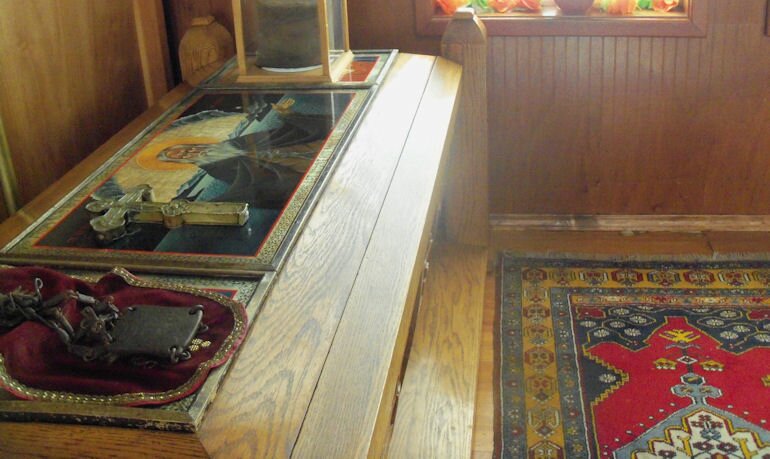
In 1970, the Orthodox Church officially glorified Saint Herman of Alaska, recognizing him as the first Orthodox saint of North America. His relics are preserved at Holy Resurrection Cathedral in Kodiak, while his grave on Spruce Island remains a powerful place of pilgrimage.
Countless faithful testify to healings, protection, and spiritual consolation through his intercessions. Soil from his grave and water blessed by prayer continue to bring comfort and hope to those who approach him with faith.
The Teachings of Saint Herman: Hope Without Despair
Saint Herman’s letters and sayings reveal the heart of a true spiritual elder:
“From this day, from this hour, from this minute, let us strive to love God above all, and fulfill His holy will.”
He taught that despair is never from God, and that repentance opens the door to joy:
“A true Christian is made by faith and love toward Christ… Our sins do not hinder our Christianity if we repent. Here one needs the shield of faith.”
For Saint Herman, holiness was not a life without struggle, but a life anchored in trust in God’s mercy.
Patron Saint of North America
Today, Saint Herman of Alaska is honored as the patron saint of North America, a protector of indigenous peoples, and a guide for monks, missionaries, and lay Christians alike. His life proclaims an eternal truth: where humility and love dwell, Christ Himself abides.
His message to every generation remains simple, powerful, and life-giving:
Love God above all. Do not lose hope.