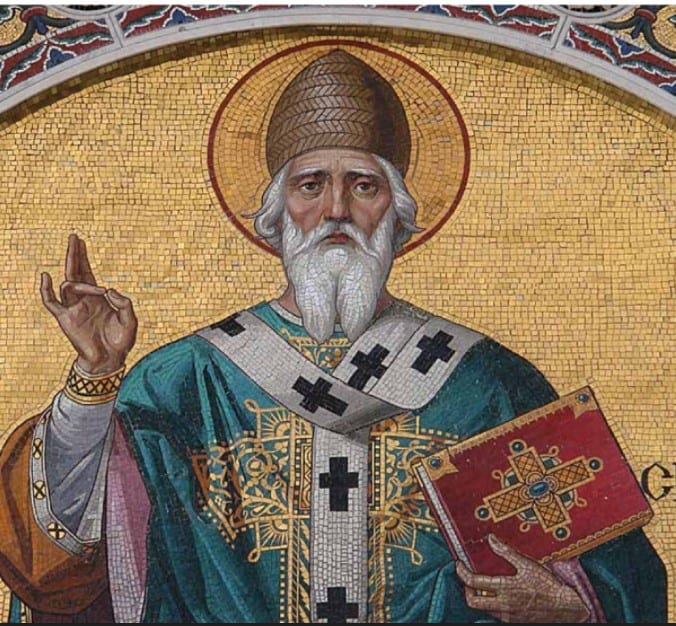
Saint Spyridon of Trimythous stands among the most beloved saints of the Orthodox Church—a shepherd-turned-bishop whose life proclaims a timeless truth: God reveals His power through humility, mercy, and simple faith. Though unlearned in worldly wisdom, Saint Spyridon became a vessel of divine grace, working miracles that strengthened the Church, defended the Orthodox faith, and comforted countless souls.
Born in the village of Assia on the island of Cyprus, Saint Spyridon lived during a turbulent yet grace-filled era of the Church. His life bridges the world of the humble shepherd and the great councils of the Church, revealing how holiness—not education, rank, or wealth—is the true measure of greatness.
This spiritual biography, drawn from ancient Church tradition and later Byzantine sources, invites us to encounter not merely the wonders of a saint, but the living God who acts through those who love Him.
From Shepherd to Bishop: The Humble Beginnings of a Saint
Saint Spyridon was born in Assia, Cyprus, to poor and simple farming parents. From childhood, he worked as a shepherd, tending sheep with patience and gentleness. Though materially poor, he was rich in virtue—humble like David, simple-hearted like Jacob, and hospitable like Abraham.
He married young and had one daughter, Irene. Together with his wife, he lived a quiet, God-pleasing family life marked by prayer, charity, and contentment. When his wife reposed early, Spyridon devoted himself even more fully to God. According to tradition, he entered monastic life, while his daughter Irene embraced the ascetic path in a convent, where she later reposed in holiness.
Freed from worldly attachments, Saint Spyridon gave away his possessions to care for strangers, widows, and the poor. His life of mercy and prayer so pleased God that he received the gift of miracle-working—healing incurable diseases and casting out demons by the power of Christ.
Because of his holiness, he was chosen as Bishop of Trimythous (Tremithous), in what is today the Larnaca District of Cyprus. Yet even as a bishop, Saint Spyridon remained outwardly simple, often dressed as a peasant and continuing to shepherd sheep, never abandoning the humility that had shaped his soul.
Miracles of Mercy: Feeding the Hungry and Humbling the Proud
During a devastating drought and famine on Cyprus, many perished from hunger. Seeing the suffering of the people, Saint Spyridon prayed fervently, and God opened the heavens. Rain fell abundantly for days, restoring the land and bringing a rich harvest.
Years later, another famine struck. Wealthy grain merchants hoarded food, raising prices and exploiting the poor. One merciless merchant refused to help a starving man and his family. The poor man went weeping to Saint Spyridon, who comforted him and foretold that God Himself would intervene.
That very night, a violent storm destroyed the greedy merchant’s storehouses, scattering grain throughout the city. The poor gathered freely what they needed, while the once-proud rich man was humbled. Thus, God judged cruelty and rewarded trust, revealing that mercy is stronger than wealth.
Gold Becomes a Serpent: God’s Power Over Creation
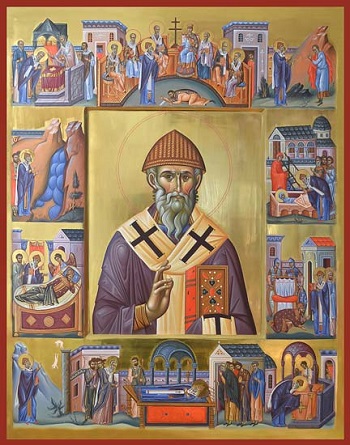
In another famine, a desperate farmer begged the same merchant for grain on credit and was refused. Saint Spyridon gave the farmer a lump of gold to use as collateral. Later, when the debt was repaid, the saint returned the gold to God in prayer.
Before the farmer’s eyes, the gold turned back into a serpent and slithered away—revealing that God had temporarily transformed creation itself to save His child. This miracle taught a profound lesson: everything belongs to God, and He provides exactly what is needed, when it is needed.
Defender of the Orthodox Faith at the First Ecumenical Council
In 325 AD, Saint Spyridon attended the First Ecumenical Council in Nicaea, convened under Emperor Constantine the Great to confront the heresy of Arius, who denied the full divinity of Christ.
Though simple and untrained in philosophy, Saint Spyridon became one of the most powerful witnesses for Orthodoxy. When a proud pagan philosopher mocked the faith using clever arguments, the saint responded not with rhetoric, but with divine wisdom and living faith.
According to sacred tradition, Saint Spyridon took a potsherd (or brick) into his hands and said:
“In the name of the Father”—and fire rose upward; “And of the Son”—and water flowed downward; “And of the Holy Spirit”—and only clay remained in his hand.
Through this miracle, he revealed the mystery of the Holy Trinity: three distinct Persons, yet one God. The philosopher, struck not by words but by divine power, confessed the truth of the Christian faith and was converted.
Thus was fulfilled the Scripture: “The Kingdom of God is not in word, but in power” (1 Corinthians 4:20).

Visions, Healings, and Resurrection of the Dead
Saint Spyridon’s miracles extended even beyond death:
He halted a raging river by command, as Joshua once stopped the Jordan, in order to save an innocent man from execution.
He exposed hidden sins—not to condemn, but to lead souls to repentance and healing.
He spoke with his departed daughter Irene to recover property entrusted to her, showing God’s dominion over life and death.
He healed Emperor Constantius through prayer, refusing wealth and giving all gifts to the poor.
He raised a pagan child from the dead—and then, through fervent prayer, raised the child’s mother who died from overwhelming joy.
Each miracle proclaimed the same message: Christ is alive, compassionate, and present among His people.
A Saint of Humility, Even in Power
Despite his miracles, Saint Spyridon remained profoundly humble. He continued tending sheep, correcting wrongdoing gently, and living simply. When thieves once tried to steal his sheep, God restrained them. Instead of punishing them, the saint released them, gave them a sheep, and taught them to live honestly by their own labor.
Even animals obeyed him—exposing dishonesty and revealing truth without a word spoken.
Heavenly Worship on Earth
On one occasion, Saint Spyridon served Vespers with only a few clergy present. When he proclaimed, “Peace be unto all,” an unseen angelic choir responded, filling the church with heavenly song. Those who rushed in heard nothing once they entered—reminding us that heaven and earth unite where holiness dwells.

Relics, Veneration, and the Living Presence of the Saint
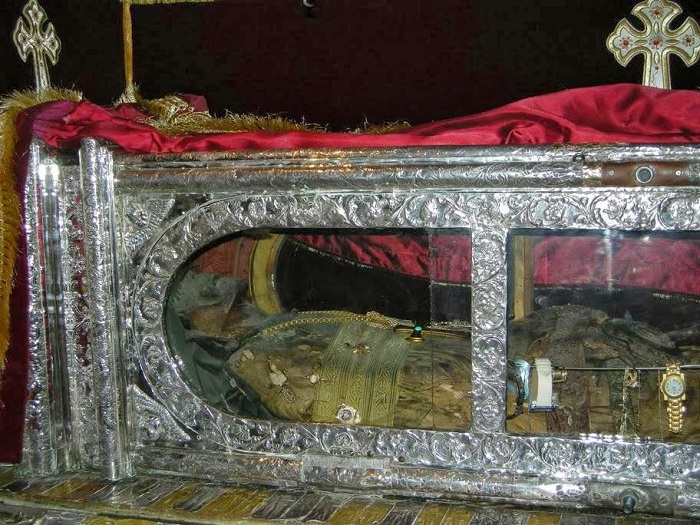
In the 7th century, during Arab invasions of Cyprus, the saint’s holy relics were transferred to Constantinople, where they were found incorrupt, bearing a sprig of basil—known as the “royal plant”—as a sign of divine favor.
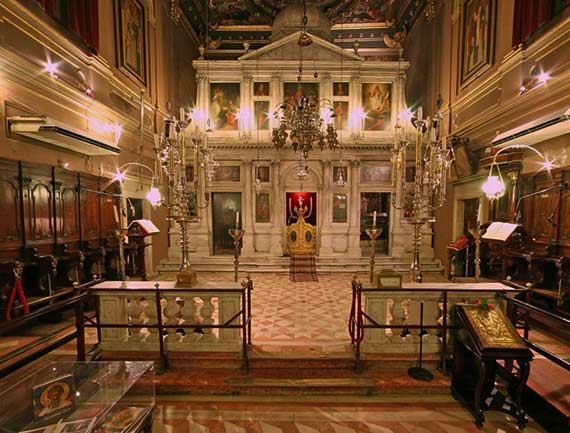
After the fall of Constantinople in 1453, the relics were brought to the island of Corfu, where they remain today in the Church of Saint Spyridon. There, the saint is venerated as “the Keeper of the City”, protector of the island from plague, famine, and invasion. His right hand, once kept in Rome at the Church of Santa Maria in Vallicella, was returned to Corfu in 1986.
Each year, Saint Spyridon’s relics are carried in solemn procession—especially on Palm Sunday and August 11—with the participation of all Corfu Philharmonic societies, bearing witness that the saint remains spiritually alive among his people.
Saint Spyridon, Protector of Corfu and Patron of the Faithful
Saint Spyridon is the patron saint of potters, a reminder of the humble clay through which God reveals His glory. He is also the heavenly protector of Corfu, Piraeus, and countless Orthodox Christians worldwide.
The faithful believe that Saint Spyridon delivered Corfu from a deadly plague and later miraculously defended the island during the Ottoman siege of 1716, when invaders reportedly saw a monk holding a flaming torch driving them away. The victory was attributed not only to military leadership, but to the saint’s intercession.
Feast Days of Saint Spyridon
Saint Spyridon is commemorated:
December December 25 on the Julian Calendar
Cheesefare Saturday (the Saturday before Great Lent)
August 11 (in Corfu, commemorating deliverance from invasion)
In the West, he is remembered on December 14.
What Saint Spyridon Teaches Us Today
Saint Spyridon’s life is not merely history—it is a living sermon:
Humility invites divine power
Mercy opens the hand of God
Faith does not require eloquence, only obedience
True wealth is compassion, not gold
In an age obsessed with status, intellect, and success, Saint Spyridon reminds us that God delights in the lowly, and through them, He shakes the world.
Saint Spyridon the Wonderworker, pray to God for us.
If you found this life inspiring, consider exploring more Orthodox saints who reveal how ordinary lives become extraordinary when surrendered to Christ.