
Commemorated in the Orthodox Church on July 20 (August 2, Old Calendar)
In the midst of Israel’s spiritual darkness, during a time of apostasy, idolatry, and moral decline, one man rose as a burning torch of truth. That man was Elijah the Tishbite—a prophet of fire, a fearless warrior of God, a miracle-worker, and a heavenly ascetic. Few figures in Holy Scripture appear with such drama and disappear with such mystery. His life was not only marked by the miraculous but became a living icon of divine zeal, repentance, and the triumph of faith over falsehood.
Elijah is one of the most celebrated Old Testament saints in the Orthodox Church. His feast day on August 2nd is observed with solemnity and joy throughout the Orthodox world, particularly in Slavic and Middle Eastern traditions. Known as a model of ascetic life, a patron of monastics, and a forerunner of the Second Coming, Elijah remains one of the most beloved figures in the Christian spiritual imagination.
A Prophet Born of the Wilderness
The Scriptures tell us little about Elijah’s early life. He appears suddenly in 1 Kings 17, described simply as “Elijah the Tishbite, of the inhabitants of Gilead”—a mountainous and rugged region east of the Jordan River, associated with wildness, strength, and solitude. His very name, Eliyahu in Hebrew, meaning “My God is Yahweh”, declares his mission. Elijah’s presence is thunderous from the outset. He confronts the wicked King Ahab of Israel, who—under the influence of his wife Jezebel—had led the people into Baal worship and spiritual ruin.
With fiery authority, Elijah pronounces a divine curse: “As the Lord God of Israel lives, before whom I stand, there shall not be dew nor rain these years, except at my word” (1 Kings 17:1). Thus begins a drought that lasts three and a half years—a symbol of the spiritual drought afflicting Israel.
Miracles of Mercy in a Time of Judgment
Though his mission is one of warning and confrontation, Elijah is also a vessel of divine compassion. During the drought, God hides him at the Brook Cherith, where he is miraculously fed by ravens—unclean birds, yet chosen as God’s servants. When the brook dries up, God sends Elijah to Zarephath, a Gentile town near Sidon, where a destitute widow prepares to eat her last meal and die with her son.
Elijah asks her to give him the last of her flour and oil. She does so in faith, and God performs a miracle: her jar of flour and jug of oil never run dry for the rest of the famine. When her son dies unexpectedly, Elijah prays fervently and the boy is raised from the dead—the first recorded resurrection in the Bible (1 Kings 17:22). These events reveal Elijah not just as a prophet of judgment, but of life-giving power and intercessory love.
Mount Carmel: The Fire of the True God
The climactic moment in Elijah’s ministry comes on Mount Carmel, in one of the most dramatic confrontations in all of Scripture. In 1 Kings 18, Elijah stands alone against 450 prophets of Baal and 400 prophets of Asherah. He challenges them to a public test: each group will prepare a sacrifice and call upon their god. The true God will answer by fire.
All day the prophets of Baal cry out, cut themselves, and dance frantically. But there is no answer. Elijah mocks them: “Maybe he is sleeping… or on a journey.” When it is Elijah’s turn, he rebuilds the altar of the Lord with twelve stones, digs a trench, and pours water over the sacrifice three times. Then he prays a simple, faithful prayer:
“O Lord, God of Abraham, Isaac, and Israel, let it be known this day that You are God in Israel and I am Your servant.”
(1 Kings 18:36–37)
Fire falls from heaven, consuming the offering, the wood, the stones, the dust, and even the water. The people fall on their faces and cry: “The Lord, He is God! The Lord, He is God!” Baal is exposed as a fraud. Elijah commands the false prophets to be executed, and the curse is lifted—rain returns to the land.
This miraculous sign was not only a vindication of Elijah’s mission—it was a moment of national repentance and divine mercy.

The Cave at Horeb: The Still Small Voice
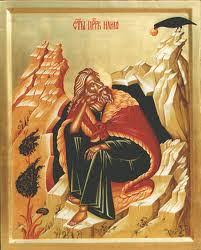
But Elijah’s story doesn’t end in triumph. Queen Jezebel vows to kill him. Terrified, Elijah flees into the wilderness, collapses under a juniper tree, and prays for death: “It is enough; now, O Lord, take away my life” (1 Kings 19:4). It is here we see the humanity of the prophet—his exhaustion, isolation, and despair.
God sends an angel to feed him and lead him to Mount Horeb (Sinai), the mountain of Moses. There, in a cave, Elijah encounters God—not in wind, earthquake, or fire, but in a still small voice (1 Kings 19:12). This moment is one of the most profound in Scripture: God’s voice is not always loud and dramatic. It often comes in stillness, silence, and humility.
Elijah is renewed. God reveals to him that he is not alone—7,000 faithful remain who have not bowed to Baal. He is given a new mission: to anoint kings and to call Elisha as his successor.
Elijah’s Glorious Departure: The Chariot of Fire
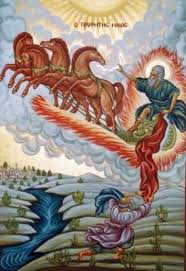
One of the most awe-inspiring moments in all of Scripture is Elijah’s departure from this world. In 2 Kings 2, he and Elisha walk together toward the Jordan River. Elijah strikes the water with his mantle and it parts, allowing them to cross on dry land—recalling Moses at the Red Sea and Joshua at the Jordan.
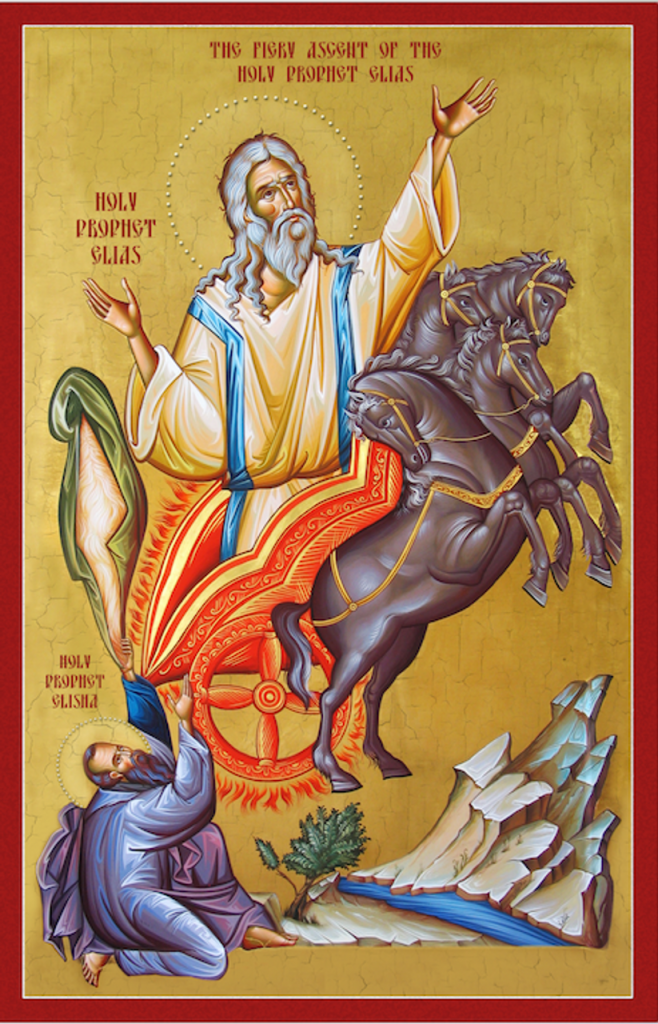
Then, a chariot of fire and horses of fire appear, separating the two, and Elijah is taken up into heaven in a whirlwind (2 Kings 2:11). Unlike every other prophet or patriarch, Elijah does not die—he is translated alive, a foreshadowing of the bodily resurrection and the ascension of Christ.
Elisha takes up Elijah’s mantle and continues his prophetic work. The Spirit of Elijah rests upon him.
Elijah in the New Testament and the Church
Elijah’s role continues in the New Testament. He appears on Mount Tabor during the Transfiguration of Christ (Matthew 17:3), alongside Moses, symbolizing the Law and the Prophets. Both had fasted 40 days, both encountered God on Mount Sinai, and both conversed with Christ about His upcoming Passion. This shows that the Gospel is the fulfillment of both Law and Prophecy.
Christ also identifies John the Baptist as the “Elijah who is to come” (Matthew 11:14)—not a reincarnation, but a spiritual successor who prepares the way of the Lord with Elijah’s same fire and truth.
In Orthodox eschatology, Elijah is expected to return before the Second Coming, alongside Enoch, as one of the two witnesses (Revelation 11:3–12) who will oppose the Antichrist and call the world to repentance. He is a forerunner of the final judgment, just as he was a forerunner of repentance in ancient Israel.

Elijah the Ascetic and Monastic Model
Orthodox tradition honors Elijah not only as a prophet but as a model of asceticism and watchfulness. He lived in the wilderness, fasted, prayed with fervor, performed miracles, and spoke fearlessly against sin. In many ways, he is considered the father of desert monasticism. The Prophet Elijah is a spiritual ancestor of St. John the Baptist, of St. Anthony the Great, and of all monks and nuns who renounce the world to live with God.
His feast is celebrated with processions, blessings of water, and often with prayers for rain and good harvest, as his prayers both withheld and gave rain.
Hymns from the Church
Troparion (Tone 4):
An angel in the flesh and the cornerstone of the prophets,
the second forerunner of the coming of Christ,
glorious Elijah sent grace from on high to Elisha
to dispel diseases and cleanse lepers.
Therefore, he pours forth healings on those who honor him.
Kontakion (Tone 2):
Prophet Elijah of great renown,
seer of the mighty works of God,
by your word you held back the clouds of rain!
Intercede for us, O holy one, to the only Lover of mankind!
Elijah’s Ongoing Legacy
To this day, Elijah’s name is invoked in times of drought and hardship, in moments of decision and repentance. Churches, monasteries, mountains, and villages across the Orthodox world bear his name—Profitis Ilias in Greek, Ilija in Serbian, Elias in Arabic-speaking communities. In Slavic lands, he is associated with storms, thunder, and fire, often depicted riding in a fiery chariot through the skies.
He is a prophet for all ages—unyielding in truth, aflame with holiness, a voice in the wilderness, and a forerunner of God’s final victory over evil.